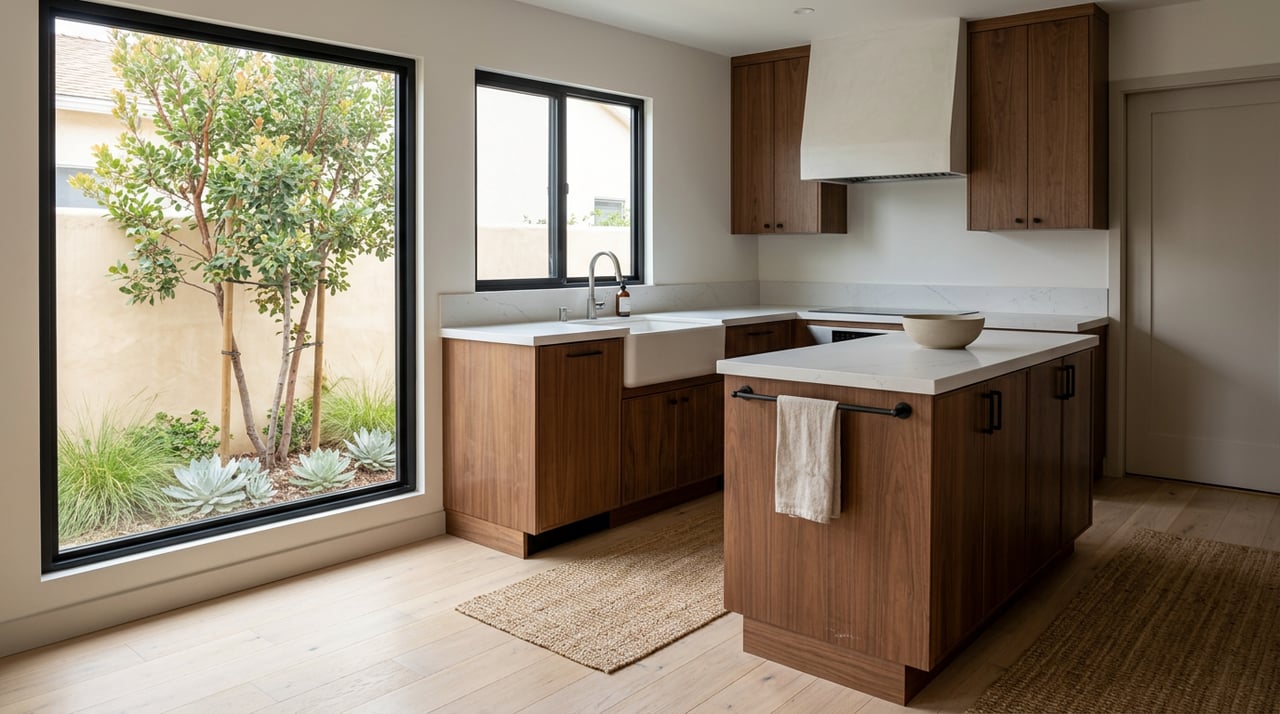
The listing photo shows a tidy studio behind the main house on a 1948 bungalow lot near Sherman Way, staged with a daybed and called a "bonus unit, ideal for guests or rental income." What the listing doesn't show is a permit history, because there isn't one. The unit was a garage before someone framed it into livable space sometime in the 1990s, and nobody at LADBS ever signed off on it.
That story is not rare in the San Fernando Valley. It is close to the median story. And for years, the honest answer to "can I legalize this" was unsatisfying: maybe, eventually, for an unknown amount of money, if the city felt like it. Two state laws that took effect in the last twenty months changed that answer from unknowable to specific. They didn't make the garage conversion legal. They gave the seller a number to work with, and that number is what actually moves at the negotiating table.
The Garage Conversion Is the Valley's Default ADU
Most of Van Nuys, and much of the surrounding Valley, was built out in the 1940s and 1950s on parcels running 5,500 to 6,500 square feet, smaller than the standard west Valley lot. After the primary house footprint and required setbacks eat into that space, there is often no room left for a new detached accessory dwelling unit. The garage that came with the house is the only structure with a foundation and four walls already in place, which is why converting it, rather than building something new in the backyard, has become the dominant path to a second unit here. Van Nuys files more ADU permits than any other Los Angeles neighborhood, year after year, and the pattern skews heavily toward garage conversions and attached units rather than ground-up detached builds.
The problem is that most of those garages were never engineered as living space. A slab poured for parking a car is not the same as a slab poured to code for someone to sleep on. That single fact, more than paint or finishes, is what an inspector finds first.
What Sacramento Actually Changed
Assembly Bill 2533 was signed on September 28, 2024, and took effect January 1, 2025. Before it, a city could deny a legalization permit for an unpermitted ADU or JADU simply because the unit didn't meet the building code that was in effect when it was built, which for a 1990s garage conversion meant almost automatic denial. AB 2533 removed that excuse. A city can now only reject an amnesty application if the unit is genuinely substandard under Health and Safety Code Section 17920.3, meaning a real threat to health and safety, not a paperwork gap. The law also bars cities from charging impact or connection fees on these units unless new utility infrastructure is actually required.
Los Angeles runs this state amnesty alongside an older local rule, the 2017 Unpermitted Dwelling Unit Ordinance, which requires anyone legalizing a unit under that city program to designate at least one low or moderate income unit per legalized dwelling. LADBS accepts AB 2533 applications without that affordability requirement attached. That is the detail that changes outcomes for two sellers with what looks like the identical unit: whether the file gets routed as an AB 2533 amnesty application or gets pulled into the older city ordinance determines whether an affordability covenant is part of the deal at all. A regional planning agency guidance memo on the amnesty program lays out how the two tracks interact, and it is worth a seller's contractor or agent actually reading before assuming which path applies.
The Clock Now Has a Number
Senate Bill 543 took effect January 1, 2026, and it addressed a different complaint: applications sitting in limbo with no deadline for the city to even say whether the paperwork was complete. Under SB 543, a jurisdiction now has roughly fifteen business days to issue a completeness determination on an ADU application. That is not a promise of full approval in fifteen days. It is a promise that the seller or homeowner will not be waiting months just to find out whether the submission is missing something.
SB 543 also redefined how square footage is measured, so that the protected 800 square foot cap on a detached ADU now applies to interior livable space only. Thicker exterior walls, stair enclosures, and mechanical rooms no longer count against that cap, which in practical terms frees up somewhere between 50 and 120 additional square feet on a typical project. And it reinforced fee exemptions already on the books: units at 750 square feet of interior livable space or less can skip most impact fees, and units at 500 square feet or less can skip school impact fees too, which in Los Angeles have run several dollars per square foot on top of tens of thousands in combined city fees.
What Bounded Risk Actually Looks Like
Before 2025, an unpermitted garage conversion in the Valley was priced by buyers and their lenders as an open-ended liability. There was no ceiling on what fixing it might cost, and no floor on how long it might take, because the city could simply say no. That uncertainty is what pushed serious buyers toward walking, or toward demanding a discount large enough to cover a worst case nobody could actually calculate.
What exists now is closer to a known range. Industry cost guides put typical corrective work to clear the amnesty safety checklist at $10,000 to $50,000, with severely deteriorated units running higher. Application fees in cities that have published schedules tend to land between $570 and $800. Total time from application to a certificate of occupancy or compliance is commonly cited at two to six months. None of that is cheap, and none of it is fast. But it is knowable, and a seller who has already run the numbers can defend a price in a way that a seller who says "we're not sure what it would take" cannot.
What Still Doesn't Change
Legalization eligibility and lending reality are two separate questions, and conflating them is where sellers get tripped up. A unit accepted into the AB 2533 pathway is not automatically counted as legal square footage by an appraiser, and it does not automatically become insurable rental income until the certificate of occupancy is actually issued. FHA financing in particular remains strict about unpermitted additions that touch structural integrity or safety, amnesty program or not.
Disclosure obligations haven't moved either. California Civil Code Section 1102 still requires sellers to disclose known material facts, including unpermitted work, whether it happened during their ownership or before they bought the house. The Transfer Disclosure Statement still asks directly about room additions and structural alterations. Skipping that step because "there's an amnesty program now" is not a defense if a buyer later claims fraud.
Where the File Actually Gets Reviewed
For Valley properties inside the City of Los Angeles, ADU and legalization applications route through the LADBS Valley regional office at 6262 Van Nuys Boulevard, a Development Services Center handling plan review, permitting, inspection, and enforcement for the entire San Fernando Valley. Because Van Nuys alone generates more ADU permit filings than any other neighborhood in the city, the plan checkers there see garage conversion patterns constantly, which in practice means fewer surprises in the review than a homeowner might expect walking in cold. Sellers should also budget for a pre-inspection review of the foundation. Garages built before modern footing requirements often need underpinning, typically running $8,000 to $15,000, before the structure will pass at all.
A Sequence That Actually Helps at Listing
- Pull the full permit history from LADBS before you price the home, so you know whether the garage conversion shows up anywhere in city records.
- Get a written assessment of which pathway applies, the state AB 2533 amnesty track or the older city UDU ordinance, since the affordability terms differ.
- Ask a licensed contractor for a scoped bid on the corrective work the amnesty safety checklist would require, not a general remodel estimate.
- Confirm with your lender's or the buyer's likely lender what an unresolved unit means for appraisal and financing, before a buyer's loan officer surfaces it during escrow.
- Decide, with real numbers in hand, whether to complete legalization before listing, price the home with the corrective cost disclosed as a credit, or market to a buyer pool comfortable closing before the unit is fully resolved.
FAQ
Does AB 2533 apply if the garage conversion was built after 2020? No. The amnesty pathway only covers ADUs and JADUs constructed or converted before January 1, 2020. Anything built after that date has to go through standard permitting, not the amnesty track.
Will a legalized unit count as square footage on the appraisal? Only once the city issues a certificate of occupancy or compliance for the unit. Until that happens, most appraisers will not count it as legal living area, regardless of how far along the amnesty application has progressed.
Does the fifteen business day rule under SB 543 mean my permit is approved in three weeks? No. That window covers only the city's determination that your application is complete, not full approval of the project. Complex or unusual sites can still take considerably longer to clear plan check after that point.
If you're weighing whether to legalize before you list, or whether a Valley home you're considering has room on the lot for something the current garage conversion can't offer, AVRE Group can walk through the specific file with you before you make either move.